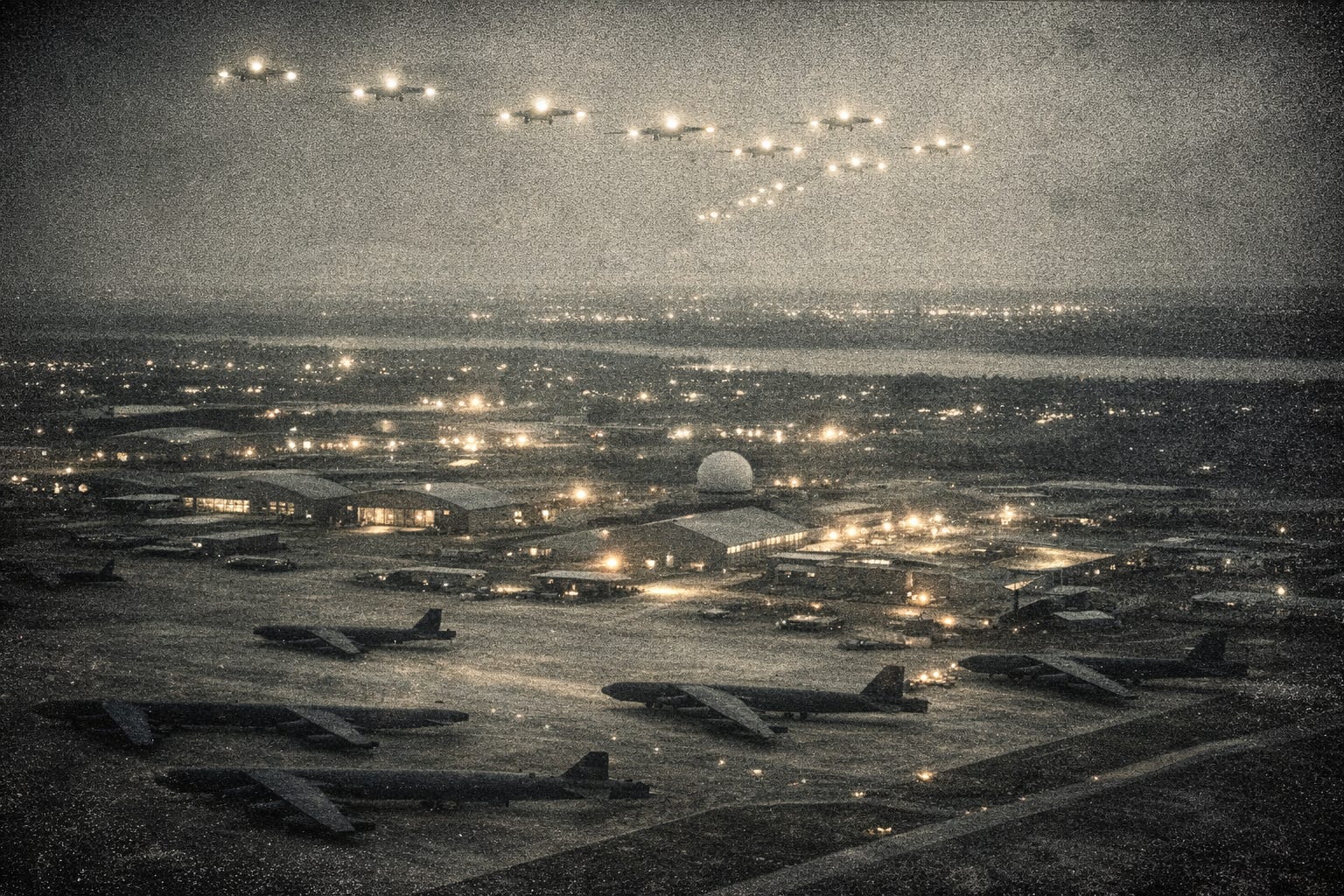
Nobody’s Talking About: The Air Incursion Over One of the Most Sensitive Bases in the U.S.
Drone Swarms. Twelve to fifteen at a time, moving through restricted airspace over a base that is built—literally and procedurally—to prevent exactly that.

There are military bases you’ve heard of—and then there are the ones that only become known after something has already gone wrong.
Barksdale Air Force Base is the latter.
This is where the U.S. parks part of its nuclear deterrent in plain sight. Rows of B-52s—aging on paper, still very much in the game—capable of carrying payloads that don’t get discussed casually. It’s also home to Global Strike Command, which is about as subtle a name as you can give to the part of the military responsible for making sure the end of the world, if it comes, is organized.
And when the country actually thought it might be under coordinated attack during the September 11 attacks, this is where George W. Bush was taken. Because it was controllable.
Then something alarming.
Early March. Multiple nights. Swarms of drones.
Twelve to fifteen at a time, moving through restricted airspace over a base that is built—literally and procedurally—to prevent exactly that.
They weren’t buzzing randomly. They weren’t crashing into things or maneuvering erratically like some dingus with a Best Buy quadcopter. They moved with purpose. They stayed long enough to matter. And then they came back the next night and did it again.
At one point, operations were disrupted enough that personnel were told to shelter in place. Which is not a normal sentence for a place like Barksdale.
... and there’s something else.
No video. No stills. Not even shitty disputable video from somebody’s iPhone at the permitter fence. For an event that played out over multiple nights, over one of the most monitored pieces of airspace in the United States—that absence is a little suspect, no?
It’s not like there aren’t a lots of sensors at a base like that. NORAD! Where you at? Anything? Silence.
If there’s no footage or independent imagery? Then where does this report even come from? Everything we “know” about this incident comes from official channels—statements, briefings, and reporting that traces back to the same handful of defense sources.
Which puts this story in a strange category:
It’s something we’ve been told happened. The entire public version of events exists inside a very controlled frame—one where the details are specific enough to raise questions, but incomplete enough that you can’t fully test them.
So what AREN’T they. We already have a working catalogue of what modern drone warfare looks like thanks to the Russia-Ukraine War. It’s messy, loud and very human.
- FPV drones, patched together with spare parts, Commercial quadcopters dropping explosives, Iranian style Shahed drones that sound like lawnmowers with a death wish. They emit signals and behave in ways we understand.
“Electronic countermeasures were not effective.”
I’m sorry—what?
This is the U.S. Air Force talking about unidentified drones operating over a nuclear-capable base.
Not partially degraded. Just… not effective.
Now, there are boring explanations for that:
The drones could have been pre-programmed—no active signal to jam
They could have been operating on frequencies or methods that weren’t easily detectable
There are legal and operational limits to how aggressively you can jam things over U.S. airspace
All true.
But none of that explains why this kept happening over multiple nights without a visible adjustment that shut it down. The U.S. military is very good at learning quickly when something exposes a weakness.
Run the Math Yourself
If you’re flying a conventional drone operation over a target like Barksdale, you need: A launch point within range, A control method (RF, satellite, relay). You can’t fly blind. Yet they found no detectable signal or identified launch site.
What’s left is a little uncomfortable -- perhaps the system was more autonomous than expected. Or the control method is outside of the realm of investigation. In other words adversaries may have a technological edge. You don’t need exotic physics or classified UAP tech to make this story uncomfortable.
… but still.. what were they?
If you run through everything we do understand, it still doesn’t quite fit—and that middle ground opens itself up a wide variety of concerns.